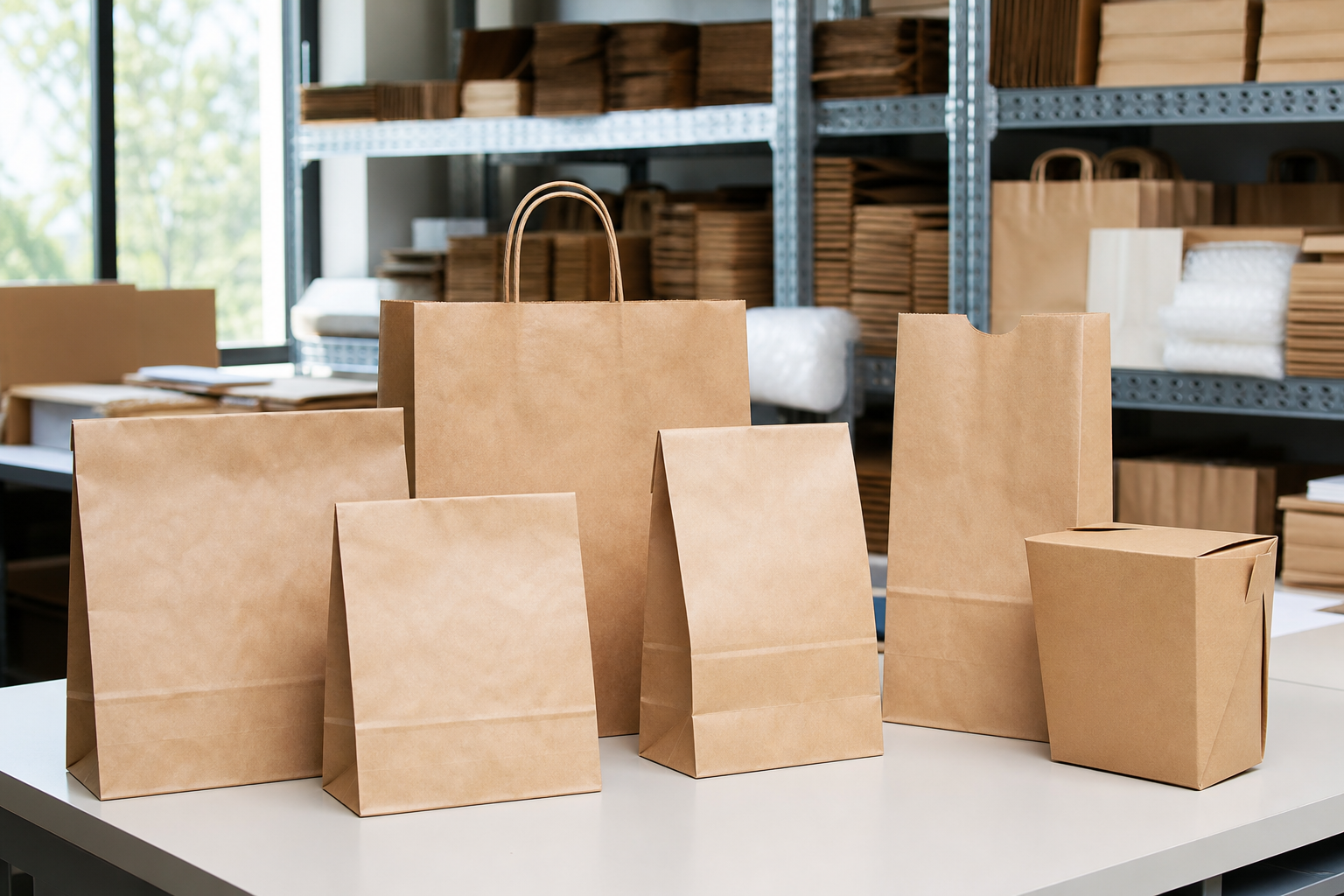
Quick answer: Packaging paper names describe different things: the fiber material, the sheet or board structure, and sometimes a surface treatment. Choose by the job the finished package must do. A carry bag, a folded carton, a shipping box and a baking liner should not be treated as interchangeable just because each contains paper.
This guide explains general material choices. It does not establish the composition, food-contact suitability, heating limits or disposal instructions of any particular Armala product.
What is packaging paper made from, and how is it manufactured?
Paper starts with pulp that is formed into a base sheet; some papers receive a coating afterward. Sappi describes the sequence from wood to pulp, base paper and coating. This explains why the word “paper” alone does not identify everything in the finished package. Sappi: The Paper Making Process
Ask for the exact grade and the finished construction. A material description should distinguish the fiber base from coatings, laminations, adhesives and printing. Do not infer recycled content from a brown color or assume that a white surface identifies a particular coating.
What does kraft paper mean for a packaging buyer?
Kraft paper is a family of packaging papers, not one fixed purchasing specification. Mondi’s kraft portfolio includes different grades and options combining fresh and recycled fibers. A grade name and technical sheet tell you more than the word “kraft” by itself. Mondi: Kraft Paper
For a bag or wrap, the useful question is whether the proposed grade and converted package suit the packed product. The benefit of comparing named grades is that suppliers can respond to the same specification. The drawback of buying by appearance alone is that different constructions can be grouped under the same broad name. For bag-specific material questions, use our paper bag materials guide.
How is corrugated board different from solid paperboard?
Corrugated board has a fluted paper medium attached to flat liners. The Fibre Box Association explains that the flutes separate the liners and contribute to rigidity and cushioning. Solid paperboard does not use that fluted construction; identify which structure a proposed carton actually uses. Fibre Box Association: What Is Corrugated?
Corrugated construction is useful when the design calls for a protective outer box, but its structure alone does not prove that a particular packed item will survive a delivery route. Request the board specification and test the complete packed order. For paperboard, compare documented thickness and stiffness as well as grammage: Holmen’s technical sheet lists these as separate properties. Holmen: Incada Exel Technical Data Sheet
What do coated, grease-resistant and baking papers tell you?
These descriptions are starting points for checking the exact treatment and intended use. They are not a universal permission to contact food, hold liquids or enter an oven. FDA distinguishes food types and use conditions, and explains that the status of a food-contact material depends on its components. FDA: Food Types and Conditions of Use FDA: Regulatory Status of Food Contact Material Components
Do not equate wax paper with parchment. Reynolds describes wax paper as a wax-coated sheet and gives different oven-use guidance for its parchment products. Those manufacturer instructions apply to those products; they do not establish an Armala item’s temperature limit or suitability. Check the instructions for the exact liner you intend to buy. Reynolds: Parchment Paper Rolls and FAQs
A useful treatment may address a specific handling requirement, but it creates another specification to verify. Ask which side is treated, which side contacts the product, and whether the supplied documentation covers the finished printed or converted article.
How should buyers compare the main options?
Compare the packaging job first, then the grade and finished structure. The following is a purchasing framework, not a list of Armala stock or approved applications.
- Bag or flexible wrap: investigate the named paper grade, dimensions and converted construction. Verify the packed load and handling sequence rather than requesting “strong brown paper.”
- Folded carton: investigate the paperboard specification and finished carton dimensions. Verify closure, fit and the required stiffness with a packed sample.
- Outer shipping box: investigate the corrugated structure, internal fit and protective packing. Test the packed assembly for its actual transport conditions.
- Direct-contact liner or baking paper: investigate the exact treatment, food-contact documentation and permitted use conditions. Do not substitute a look-alike sheet based on color or texture.
The benefit of this approach is a comparison based on the work the package must perform. Its tradeoff is that buyers need more than a product photograph: obtain the specification and evaluate a representative finished sample before accepting an alternative.
Does paper packaging automatically belong in recycling?
No. EPA advises checking what the local recycling program accepts. Its paper guidance also distinguishes clean recyclable paper from material that is unsuitable for the collection stream. Do not turn a general statement about paper into a disposal claim for an exact coated, lined or food-soiled package. EPA: How Do I Recycle Common Recyclables?
Ask the receiving program or hauler about the finished article, including its lining and likely condition after use. Recycled content and end-of-use acceptance are different questions. Avoid promising recyclability, compostability or environmental superiority without evidence for the exact package and destination.
Which specifications should buyers verify before requesting pricing?
Prepare a specification that another person can check against the sample and quotation. Record unknowns explicitly rather than letting a broad paper name stand in for an answer.
- The exact finished format, usable dimensions and intended contents.
- Named material grade, documented fiber composition and any stated recycled content.
- Grammage, thickness and relevant strength or stiffness data, with units and test methods.
- Coatings, laminations, seams, adhesives, printing and the intended contact surface.
- Food type, contact time, storage and heating conditions where relevant, together with supporting documentation.
- A packed-sample check covering fit, closures, handling and the real delivery sequence.
- The required quantity and purchasing unit; ask the supplier to state the unit covered by its price.
- Any disposal claim you need to make and the evidence supporting it locally.
What should you ask Armala before requesting a quote?
Send the format, dimensions, intended contents, quantity and use conditions, and identify the specifications still needing confirmation. Start with the Paper Bags or Paper Cups pages when those match your application, or browse the Packaging Catalog.
Request a Quote and ask for the proposed item’s specification before accepting a substitution. This guide does not confirm pricing, availability, delivery dates, custom capability or suitability for a particular application.
Frequently asked questions
Is all brown packaging paper recycled?
Do not infer recycled content from color. Ask for the named grade and documented fiber composition.
Are corrugated board and paperboard the same structure?
No. Corrugated board uses a fluted medium attached to liners. Identify the actual board construction before comparing quotations.
Does a higher grammage prove that a package is stronger?
Do not use grammage alone as proof of finished-package performance. Compare the relevant documented properties and evaluate a packed sample.
Can wax paper replace parchment for baking?
Do not make that substitution without the exact manufacturer’s instructions. Wax paper and parchment have different treatments and use guidance.
Is a paper package automatically suitable for direct food contact?
No. Obtain documentation covering the finished material and its intended food type and use conditions.
Can every paper package go into the same recycling bin?
No. Check the receiving program’s rules for the finished package, including coatings and contamination.
Does this guide confirm the material of an Armala product?
No. It provides general education. Confirm the exact item’s specification through its product documentation and quotation.
Sources used
Primary sources reviewed September 27, 2026. Manufacturer examples explain general distinctions and do not identify Armala suppliers or certify Armala products.
- Sappi: The Paper Making Process
- Mondi: Kraft Paper
- Fibre Box Association: What Is Corrugated?
- Holmen: Incada Exel Technical Data Sheet
- Reynolds: Parchment Paper Rolls and FAQs
- FDA: Food Types and Conditions of Use
- FDA: Regulatory Status of Food Contact Material Components
- EPA: How Do I Recycle Common Recyclables?
Continue exploring the Packaging Learning Center.