Quick answer: Choose a paper bag by the shape of the packed order, how it will be carried and whether food touches the bag. Compare flat or gusseted bags for individual items, block-bottom formats for a defined base, and handled carriers for carrying convenience. Confirm the exact dimensions, materials and intended use before selecting a sample. A style name alone does not establish carrying strength or food-contact suitability.
What do the different paper bag type names mean?
Bag names can describe shape, handle, presentation or use; they are not mutually exclusive categories. A bakery bag can also be gusseted and windowed. A printed bag can have a block bottom and flat handles. Separate these choices when comparing specifications.
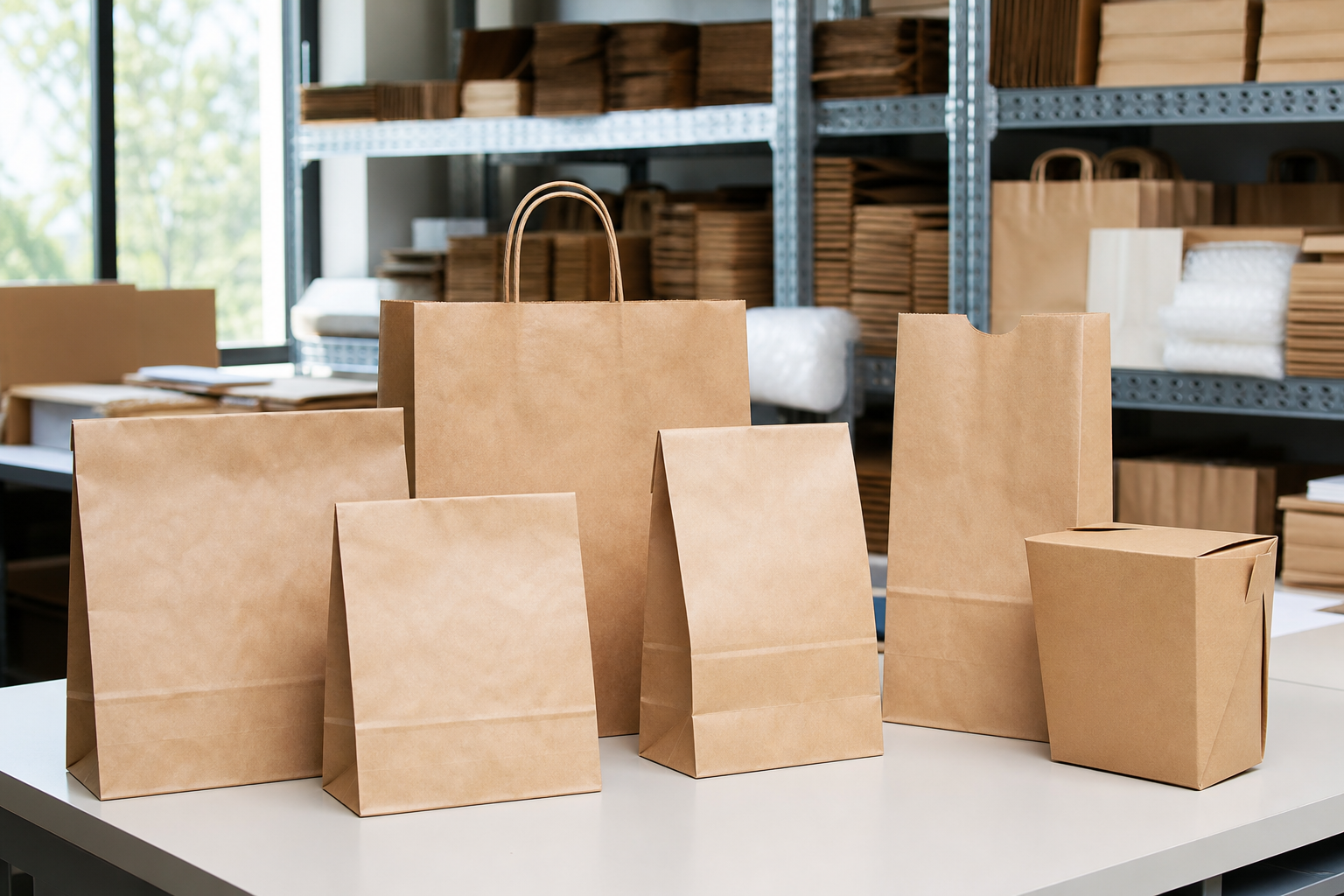
Papier-Mettler’s general packaging range distinguishes flat bags, gusseted bags, block-bottom bags, window bags and several carrier handle styles. These are industry examples, not a list of Armala’s stock or a supplier relationship. Use the following comparison as a sample-selection framework:
- Flat bag: consider it for a relatively flat individual item. Check whether the opening and finished dimensions admit the item without squeezing it. It does not give you the same defined base as a block-bottom format.
- Gusseted bag: its folded expansion area is a feature to compare when the item has depth. Ask which dimension describes the gusset; a front-view photograph is insufficient to confirm fit.
- Block-bottom bag: compare the open base against the outside footprint of a box or container. Do not substitute the bag’s front width for both base dimensions.
- Handled carrier: compare flat, twisted or other specified handles for grip and packing clearance. Handle style is a carrying choice, not proof of a higher load rating.
- Window bag: consider it when seeing the contents matters. Ask what makes up the window and how it joins the bag; the name does not establish barrier properties or disposal suitability.
What are these bags made from, and how does construction differ?
The paper body is only part of the finished construction. Request the specification for any handles, patches, windows, adhesives or surface treatments as well as the paper itself. Do not infer recycled content, coating, grease resistance or fiber origin from a brown or white appearance.
Manufacturing equipment illustrates why finished specifications matter. NEWLONG describes roll-fed SOS equipment with tube-forming and cutting sections. Its flat-handle unit folds paper tape and attaches the handle inside a bag with a paper patch; its twisted-handle equipment assembles handles with patch paper before attachment. These are examples of machine processes, not a statement about how any Armala item is made.
HolwegWeber separately lists glued flat-satchel and heat-sealed satchel constructions, including window variants. Therefore, “paper bag” does not identify one universal seam or closure process. For more general material education, read the paper bags material guide; this chapter focuses on choosing the finished format.
Which format should a bakery compare first?
Start with the actual product: an individual item, a long loaf and a boxed cake are different packing problems. Select a sample whose opening and usable interior fit that product, then verify the intended food contact.
For loose items, ask whether the complete bag is documented for the relevant food and contact conditions. For boxed items, measure the closed box, including projecting corners or tabs. If presentation matters, assess a window sample with the actual item inside. A visible window can help the buyer inspect appearance, but do not treat visibility as a promise of freshness or protection.
Record whether packing marks the surface, bends the product or makes removal awkward. If the bag requires force to insert the item, compare another size or format. This is a practical sample test, not an Armala performance guarantee.
Which format should restaurants and retailers compare?
For takeout, begin with the complete closed-container arrangement. For retail, begin with the complete purchase, including any protective packaging. Compare the bag base, opening, usable height and handle position against that arrangement.
Illustrative example: two containers that fit individually may need a different bag when packed side by side. Stacking changes the required height and the way the order is removed. Trial both arrangements rather than approving a bag from a single container measurement.
Handled bags offer a grip point, but handles also occupy space near the opening. A handle-free format may suit a handoff where the customer supports the bag differently; it may be inconvenient when the same customer must carry several other items. Ask staff to pack and carry a representative order, checking grip comfort, handle attachment, seams and base. Use the supplier’s documented limits and an agreed trial; do not invent a safe weight.
What are the benefits and drawbacks of choosing one standard bag?
One approved format simplifies the packing decision, but it should only cover orders that actually fit. Standardization is useful when staff can identify the right bag consistently; it becomes a drawback when smaller orders move around or larger orders must be forced inside.
Compare a small number of clearly assigned formats using real order combinations. Label the sample decision by contents and packing arrangement, not just “small” or “large.” Note exceptions such as a tall box, a wide container or an order that needs separate handling. These are operating choices, not claims that a particular bag will reduce costs or prevent damage.
What must buyers verify about food contact and disposal?
Verify the finished bag for its intended use and confirm disposal locally. Neither a paper appearance nor a bakery label establishes suitability for every food.
FDA distinguishes food types and conditions of use, and its regulatory guidance addresses the status of the components of food-contact materials. Ask the supplier for documentation applicable to the exact item, food, contact duration and temperature conditions. Do not infer oven, microwave, hot-fill or grease-resistance suitability.
EPA advises checking what the local recycling program accepts and removing food residue from paper and cardboard takeout containers. Ask how windows, handles, treatments and food contamination affect the complete bag’s accepted disposal route. Do not turn a general paper recycling statement into an environmental claim about an undocumented Armala product.
What should a buyer check before requesting pricing?
Send a concrete packing brief and request the exact proposed specification. Use this verification list:
- Contents, loose-food versus outer-carrier use, and the intended packing arrangement.
- Outside dimensions of the full packed order, its weight and any projecting parts.
- Bag width, depth or gusset, usable height, dimension order and closure allowance confirmed with the supplier.
- Handle construction, location and available grip space.
- Paper and other component materials, plus relevant intended-use documentation.
- Sample trial results: insertion, removal, carry comfort and observed seam or attachment issues.
- Required quantity and the supplier’s explicit unit and pack-count definitions.
- Printing requirements and written quote terms; ask for confirmed timing rather than assuming stock is faster.
Compare the live Paper Bags commercial page. If printing is part of the brief, use Custom Printed Paper Bags and the separate printing preparation guide. Then Request a Quote with your dimensions, use case and quantity so the proposed item and terms can be confirmed.
Frequently asked questions
Is a bakery bag a specific paper bag construction?
No. Bakery describes an application. Ask whether the proposed bag is flat, gusseted, block-bottom, windowed or handled, and verify its suitability for the actual food.
Does a twisted handle mean a bag carries more weight?
No load rating follows from the handle name alone. Request the finished bag specification and test the proposed sample with the complete packed order.
Can the same bag hold loose pastries and takeout boxes?
Do not assume it can. Direct food contact and carrying closed containers are different uses. Verify food-contact documentation, dimensions, closure space and sample performance for each.
Does a window bag have a paper-only construction?
Do not assume it does. Ask for the window material, attachment method and disposal instructions for the complete bag.
How should I measure a bag for a takeout container?
Record the container’s outside width and depth, the full stack height and the space needed for insertion, handles and closure. Confirm the supplier’s dimension order and trial the actual sample.
Are brown paper bags automatically recyclable?
No universal disposal instruction follows from color. Check the bag’s full construction, contamination and the receiving recycling program’s requirements.
What should I send with a paper bag quote request?
Send the use case, contents or outer pack dimensions, packed weight, bag and handle preferences, food-contact needs, quantity and printing brief. Ask for the exact specification and confirmed quote terms.
Sources Used
Primary sources reviewed September 11, 2026. Equipment and manufacturer examples explain general construction only; they do not establish an Armala supplier, manufacturing process or exact-item claim.